
By Scot Mattox, Esq., Maine Traffic Safety Resource Prosecutor
This article was originally published in the National Traffic Law Center’s Between the Lines newsletter in August 2026 under NHTSA cooperative agreement 693JJ91950010. It is reprinted here with the permission of the National Traffic Law Center.
Prosecutors reviewing impaired-driving cases often focus substantial attention on field sobriety tests while overlooking some of the most persuasive evidence in the case. Long before a driver performs the Walk-and-Turn or One-Leg Stand, officers may have already observed confusion, memory problems, divided attention deficits, impaired judgment, coordination difficulties, and other manifestations of impairment. Much of that evidence develops during the Personal Contact phase of the investigation.
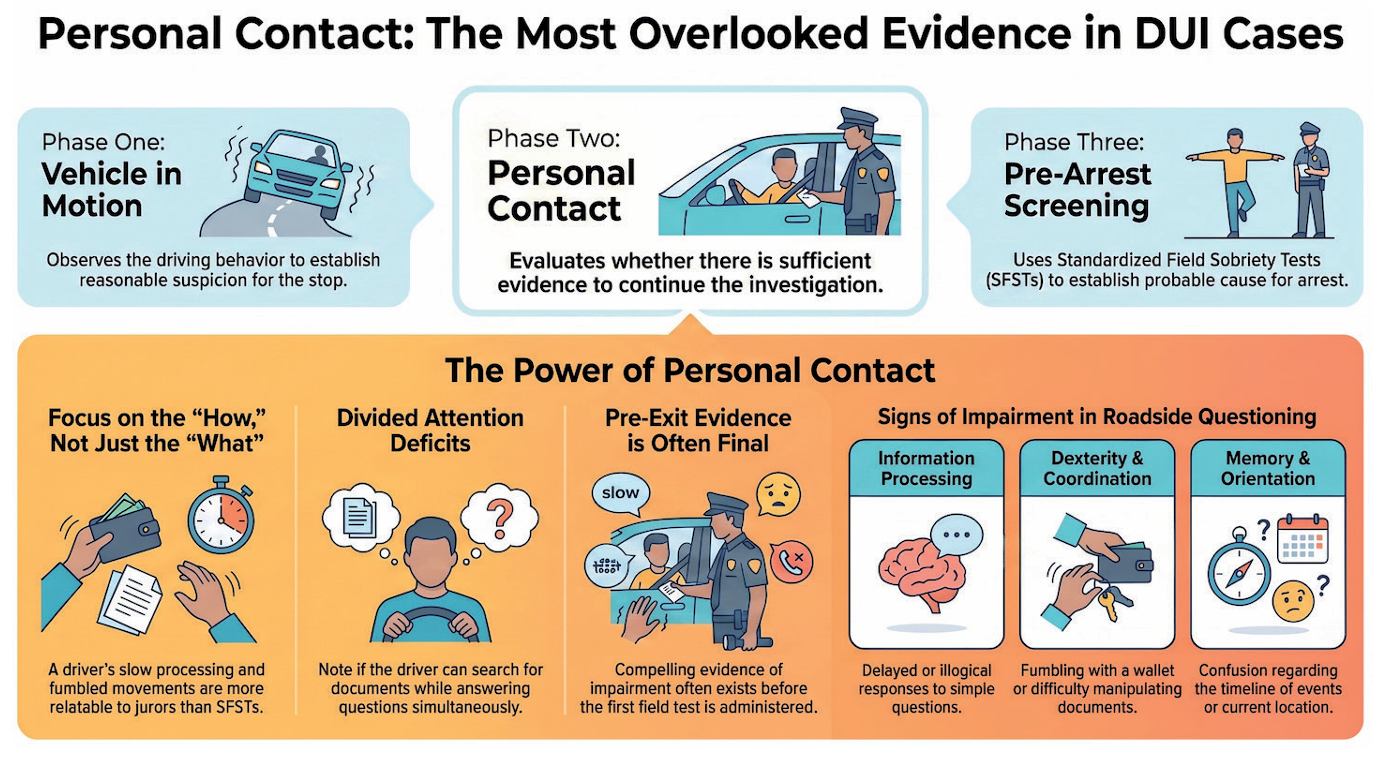
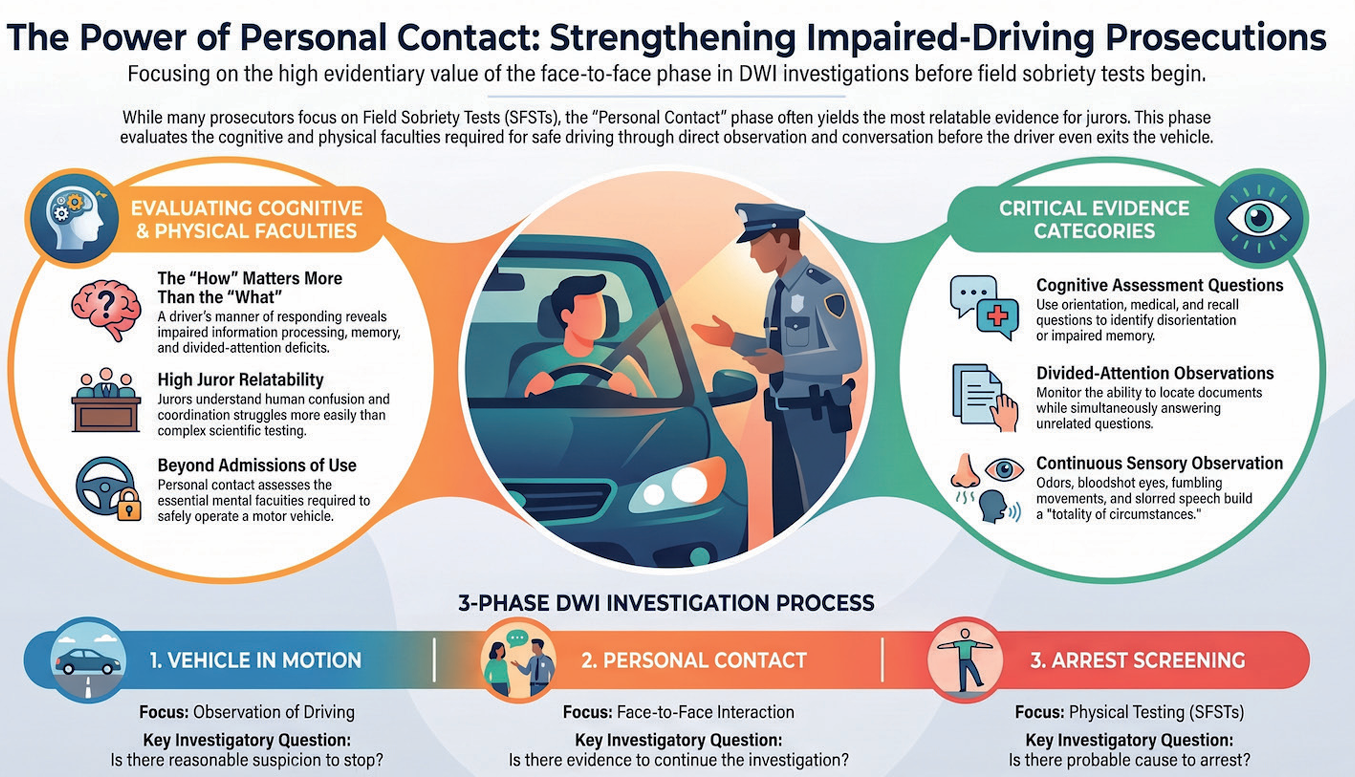
As part of the National Highway Traffic Safety Administration (NHTSA) and International Association of Chiefs of Police (IACP) DWI Detection and Standardized Field Sobriety Testing (SFST) curriculum, the impaired-driving investigation is taught as a three-phase process, each with a specific investigatory question that must be answered in order to move forward:[1]
Phase One—Vehicle in Motion: Is there reasonable and articulable suspicion to stop the vehicle?
Phase Two—Personal Contact: Is there sufficient evidence to continue the impaired-driving investigation?
Phase Three—Arrest Screening: Is there probable cause to arrest?
Of these three phases, Personal Contact frequently receives the least attention despite its substantial evidentiary value. Occurring before SFSTs are administered, this pre-arrest, non-custodial phase often generates some of the most persuasive evidence in an impaired-driving prosecution.
Few forms of evidence are more compelling than a defendant’s own words and actions. Jurors may not fully understand the science underlying Horizontal Gaze Nystagmus, but they readily understand a driver who cannot answer simple questions, remember recent events, divide attention between simple tasks, or locate basic documents. Jurors do not need specialized training to recognize ordinary human behavior.
This is not a criticism of SFSTs. Properly administered SFSTs remain scientifically validated and indispensable investigative tools.[2] The problem arises when prosecutors and investigators focus so heavily on standardized testing that they overlook the valuable impairment evidence developed before the driver ever exits the vehicle.[3]
For prosecutors, the lesson is simple: SFSTs do not begin the impaired-driving investigation—they continue one that should already be well underway.
What Is Actually Being Evaluated?
Personal Contact is more than an opportunity to obtain admissions. Its purpose is to evaluate the faculties necessary for the safe operation of a motor vehicle.
Every interaction provides an opportunity to assess perception, memory, attention, judgment, information processing, communication, coordination, dexterity, and the ability to follow instructions. The evidentiary significance lies not only in a driver’s answers but also in how those answers are provided.
A delayed response may reflect impaired information processing. Difficulty locating requested documents while maintaining a conversation may demonstrate divided-attention deficits. Confused timelines may reveal impaired memory or orientation. Slurred speech, fumbling movements, or difficulty manipulating a wallet may indicate diminished physical faculties.
Importantly, drivers are being evaluated even when no formal questioning occurs. How they search for documents, follow instructions, maintain a conversation, and react to unexpected questions may be as probative as any admission of alcohol or drug use.
When reviewing a case, prosecutors should ask not only what the driver said, but how the driver responded. Was the answer prompt and logical? Did it actually answer the question? Could the driver converse while performing another task? Did the driver understand and remember instructions?
Building Reasonable and Articulable Suspicion
By the time an officer approaches a driver’s window, a pre-contact event has already occurred. That event may be a traffic violation, unusual driving behavior, a crash, a citizen complaint, or information provided by another officer.
During Personal Contact, the question is whether the facts developed during the roadside encounter establish reasonable and articulable suspicion sufficient to justify continuing the impaired-driving investigation.
Reasonable and articulable suspicion is a relatively low legal threshold. It requires specific and articulable facts, considered together with rational inferences from those facts, that would cause a reasonable officer to suspect criminal activity.[4] Some investigations begin with substantial evidence of impairment; others begin with very little.
For prosecutors, the important question is often how the evidence developed. What did the officer know before the stop? What observations emerged during Personal Contact? When did the facts collectively justify continuing the investigation? Were innocent explanations or medical causes considered?
A sound investigation should be capable of confirming or dispelling the initial suspicion. Evidence inconsistent with impairment should not be ignored, and prosecutors who acknowledge innocent explanations often enhance their credibility with judges and juries.
Establishing the Conversation
Officers use a variety of techniques to initiate contact with drivers. Whether employing a traditional greeting identify-reason approach, verbal judo, de escalation techniques, or another professional method, the objective is the same: establish professional communication while assessing the driver.
How that interaction unfolds can significantly affect the prosecution. Professionalism increases credibility and often encourages spontaneous responses that more accurately reflect a driver’s current condition.
Personal Contact is not merely an opportunity to obtain admissions—it is an opportunity to observe. Every question and answer may reveal information about memory, judgment, attention, speech, perception, or information processing.[5] Early responses can be particularly probative because the driver may not yet appreciate the direction of the investigation or have had time to reconcile inconsistencies or tailor explanations.
Although a traffic stop is an investigative detention, voluntary roadside statements generally do not constitute custodial interrogation for Miranda purposes.[6] Prosecutors should nevertheless evaluate the circumstances of questioning, particularly as an encounter progresses toward arrest.
When reviewing body-worn camera or cruiser video, prosecutors should look beyond the content of the answers themselves and consider:
- How quickly did the driver respond?
- Were the answers logical and responsive?
- Did the driver remain focused?
- Were instructions understood?
- Could the driver converse while searching for documents?
- Did the driver forget questions or abandon tasks?
For example, a driver stopped at 2:00 a.m. who claims to be coming from work but identifies the workplace as a library invites an obvious follow-up: “Is the library open until 2:00 a.m.?” The significance may lie not only in the inconsistency itself, but also in the driver’s explanation—or inability to provide one.
Written reports necessarily summarize events, and details that appeared insignificant at the time, may become important once the complete evidentiary picture emerges. Video frequently preserves details that may receive only abbreviated treatment in written reports. Those details may prove invaluable during case review, motion practice, and trial because they allow prosecutors and jurors to evaluate the driver’s conduct directly.
Roadside Questions as Cognitive Assessment Tools
Most officers develop a collection of roadside questions they routinely use during impaired-driving investigations. There is no magic script, however. The precise wording of a question is generally less important than the mental or physical faculty it is designed to evaluate.[7]
Common roadside questions typically fall into several categories:
Orientation Questions assess awareness of person, place, time, and circumstances. Questions such as “Where are you coming from?” or “Why do you think you were stopped?” may reveal confusion, disorientation, or impaired information processing.
Medical Questions help investigators identify drivers who may require medical attention and distinguish impairment from medical conditions that produce similar signs and symptoms. These questions should be asked as early as possible during the encounter because, if a driver is experiencing a medical emergency, appropriate medical care can be provided without delay. Additionally, asking these questions early may encourage more truthful responses from an intoxicated driver before the driver recognizes the focus of the investigation.
Substance Consumption Questions It is no longer sufficient to ask a driver only whether they have “been drinking tonight.” Investigators should specifically ask not only about alcohol, but also drugs, cannabis, prescription medications, and other impairing substances. Moreover, the jury should hear not only what substance the driver consumed, but also where it was consumed, when it was consumed, how much was consumed, and over what period of time the consumption occurred.
Subjective Effects Questions ask drivers how they feel and whether they are experiencing effects from a substance. Although drivers rarely admit impairment, they often describe symptoms that corroborate other observations.
Divided-Attention Questions require drivers to perform multiple tasks simultaneously, such as searching for documents while answering unrelated questions. These interactions may reveal attention and information processing deficits.[8]
Recall Questions evaluate memory and cognitive functioning by asking drivers to describe recent activities, timelines, companions, or consumption patterns.
Collectively, these categories create opportunities to assess the mental and physical faculties necessary for safe driving. Equally important as the answers themselves are the driver’s manner of responding, consistency of those responses, and the ability to process the cognitive demands of the encounter in real time. Should the investigator obtain answers that are implausible or furtive, prosecutors need to bring those out as well whether to show possible impairment or on a consciousness of guilt theory.[9]
Plain Sight, Hearing, and Smell: Continuous Observation
During the roadside interview, officers continuously gather information through observation. The driver is being evaluated even when no questions are being asked.
For prosecutors, body-worn camera and cruiser video can be especially valuable. Written reports necessarily summarize events, and details that seemed insignificant at the time may assume greater importance when viewed within the complete evidentiary context.
Anything observed from a lawful vantage point may become relevant evidence.[10] Odors of alcohol or cannabis, masking agents, bloodshot eyes, tremors, open containers, drug paraphernalia, passenger statements, delayed responses, fumbling movements, or difficulty locating documents may all contribute to the evidentiary picture.
No single observation necessarily establishes impairment. The significance lies in the totality of the circumstances.[11]
Bloodshot eyes may result from fatigue or allergies. Difficulty locating registration documents may reflect nervousness. Slurred speech may have a medical explanation. But when those observations are combined with poor driving, inconsistent answers, delayed responses, and the odor of alcohol or cannabis, their collective evidentiary value becomes substantially greater.
Many of these manifestations require no specialized training to understand. Jurors may not remember the exact number of clues observed on a field sobriety test, but they often remember a driver who repeatedly forgot questions, struggled to locate a license, or appeared unable to perform simple tasks.
Evidence Before the Driver Exits the Vehicle
By the time a driver is asked to step out of the vehicle,[12] an observant investigator may already have developed a substantial picture of the driver’s cognitive and physical functioning.
Before the driver exits, the evidence may establish:
- Whether the driver is oriented to person, place, time, and circumstances;
- Whether the driver can follow instructions;
- Whether the driver can divide attention between tasks;
- Whether the driver can recall recent events;
- Whether the driver appears affected by alcohol, cannabis, medication, or another substance;
- Whether a medical condition may be contributing to the presentation; and
- Whether speech, coordination, memory, judgment, or perception appears impaired.
In many cases, substantial evidence of impairment exists before the first field sobriety test is administered.
For prosecutors, that means looking beyond the SFST section of the police report. During case review, motion practice, trial preparation, and direct examination, attention should be given to how the evidence developed chronologically rather than focusing exclusively on test performance.
The most useful questions are often broader: What did the officer first observe? How did the driver respond to initial contact? What cognitive or physical difficulties became apparent? Were innocent explanations considered? How did each new fact contribute to the totality of the evidence?
The strongest impaired-driving prosecutions tell that complete story.
Conclusion
Personal Contact remains one of the most productive yet underutilized phases of an impaired-driving investigation. During this stage, investigators evaluate mental and physical faculties, identify possible medical concerns, assess divided attention, gather admissions, and develop evidence that may support—or dispel—suspicions of impairment. For prosecutors, the lesson is straightforward.
Read the report chronologically. Study the available video. Listen not only to what the driver said, but how the driver said it. Consider pauses, delays, contradictions, forgotten instructions, divided-attention difficulties, and other indicators that reveal how the driver was functioning cognitively during the encounter.
Standardized field sobriety tests remain an essential and scientifically supported component of impaired driving enforcement. But by the time the first field sobriety test begins, some of the most persuasive evidence in the case likely already exists.
Prosecutors who recognize that evidence—and present it as part of the complete investigative story—will often present the stronger impaired-driving case.
___________________________________________________________________
[1] Nat’l Highway Traffic Safety Admin. & Int’l Ass’n of Chiefs of Police, DWI Detection and Standardized Field Sobriety Testing Participant Manual, Session 4.
[2] Jack Stuster & Marcelline Burns, Validation of the Standardized Field Sobriety Test Battery at BACs Below 0.10 Percent (Nat’l Highway Traffic Safety Admin. DOT HS 808 839, 1998); Jack Stuster, The Horizontal Gaze Nystagmus Test: The Use of Scientific Evidence to Improve Highway Safety (Nat’l Highway Traffic Safety Admin. DOT HS 808 078, 1995).
[3] SFST Participant Manual, Session 6, Personal Contact.
[4] Terry v. Ohio, 392 U.S. 1, 21–22 (1968) (requiring specific and articulable facts, together with rational inferences from those facts, rather than an officer’s unparticularized suspicion or hunch); United States v. Cortez, 449 U.S. 411, 417–18 (1981) (explaining that reasonable suspicion is evaluated under the totality of the circumstances and permits officers to draw objective inferences from the facts in light of their training and experience).
[5] See SFST Participant Manual, Session 6, Personal Contact.
[6] Berkemer v. McCarty, 468 U.S. 420, 439–40 (1984). (explaining that a typical traffic stop is an investigative detention rather than custodial interrogation, allowing officers to ask ordinary roadside questions without first administering Miranda warnings unless the encounter becomes custodial).
[7] See SFST Participant Manual, Session 6, Personal Contact.
[8] See SFST Participant Manual, Session 6, Personal Contact.
[9] See District of Columbia v. Wesby, 583 U.S. 48, 56–61 (2018) (considering vague and implausible answers, inconsistent accounts, evasive behavior, and other circumstances in finding probable cause); Illinois v. Gates, 462 U.S. 213, 230–39 (1983) (adopting the totality-of-the circumstances approach); Maryland v. Pringle, 540 U.S. 366, 370–72 (2003) (applying a practical, common-sense probable-cause inquiry); cf. Illinois v. Wardlow, 528 U.S. 119, 124–25 (2000) (recognizing nervous, evasive behavior as a pertinent consideration); United States v. Arvizu, 534 U.S. 266, 273–75 (2002) (requiring consideration of circumstances collectively rather than in isolation); Wilson v. United States, 162 U.S. 613, 620–21 (1896) (recognizing the evidentiary significance of an accused’s explanations of incriminating circumstances).
[10] See Texas v. Brown, 460 U.S. 730, 739–40 (1983) (explaining that an officer’s mere observation of an object in plain view from a lawful vantage point generally does not constitute a Fourth Amendment search and that information obtained through such observation may establish reasonable suspicion or probable cause).
[11] See Gates, 462 U.S. at 238 (rejecting rigid, compartmentalized analysis in favor of a practical assessment of the totality of the circumstances); Pringle, 540 U.S. at 370–71 (describing probable cause as a commonsense determination based on the totality of the circumstances); Wesby, 583 U.S. at 56–61 (emphasizing that courts must consider the cumulative force of all the circumstances rather than evaluating each fact in isolation); cf. Arvizu, 534 U.S. at 273–75 (rejecting a divide-and-conquer analysis and recognizing that facts susceptible to innocent explanations may collectively establish reasonable suspicion).
[12] This article assumes no officer-safety concerns or other circumstances warranting an earlier exit order. Readers are reminded that officers generally may direct drivers and passengers to exit a lawfully stopped vehicle as a matter of routine under Pennsylvania v. Mimms, 434 U.S. 106 (1977), Maryland v. Wilson, 519 U.S. 408 (1997), and their progeny. Nothing in this article should be interpreted as suggesting that officer safety should ever be subordinated to evidence gathering.