
By Scot Mattox, Traffic Safety Resource Prosecutor, Maine
Reprinted from Police Chief Magazine Vol. 93, No. 7, pages 20-22, July 2026. Copyright held by the International Association of Chiefs of Police, Inc., 44 Canal Center Plaza, Suite200, Alexandria, VA 22314. Further reproduction without express permission from IACP is strictly prohibited.
Impaired driving remains one of the most persistent and consequential public safety challenges facing police leaders in the United States. Preliminary U.S. data indicate that more than 39,000 people were killed in traffic crashes in 2024, with alcohol continuing to play a significant role in many of those fatalities.[1]
At the same time, enforcement and toxicology data increasingly show that drugs—particularly cannabis—are now a common factor in impaired driving. As cannabis legalization has expanded, so too has the prevalence of the substance in traffic safety cases, both alone and in combination with alcohol.[2]
For police executives, cannabis impaired driving presents a fundamentally different challenge than alcohol-impaired driving. The science is more complex, impairment does not align neatly with numeric thresholds, and public perception of risk often lags behind operational reality. Officers are encountering drivers who show clear functional impairment yet lack the traditional indicators long associated with alcohol—no odor, no admission of drinking, and no easily interpreted chemical benchmark. These encounters are no longer unusual; they are becoming part of daily patrol work.
Adapting to meet this shift requires more than incremental training updates. It demands leadership’s attention to policy, expectations, and organizational readiness. Cannabis impairment cannot be addressed by simply extending alcohol-based impaired driving enforcement models or relying exclusively on specialized personnel. Instead, agencies must emphasize observational evidence, reinforce foundational investigative skills, and ensure that patrol officers are equipped to recognize and document impairment regardless of the substance causing it.[3]
The following five priorities outline key leadership considerations for addressing cannabis impaired driving in today’s enforcement environment. Grounded in current research and field experience, they focus on how chiefs and command staff can align training, policy, and practice to meet a rapidly evolving public safety challenge, while maintaining credibility with courts, prosecutors, and the communities they serve.
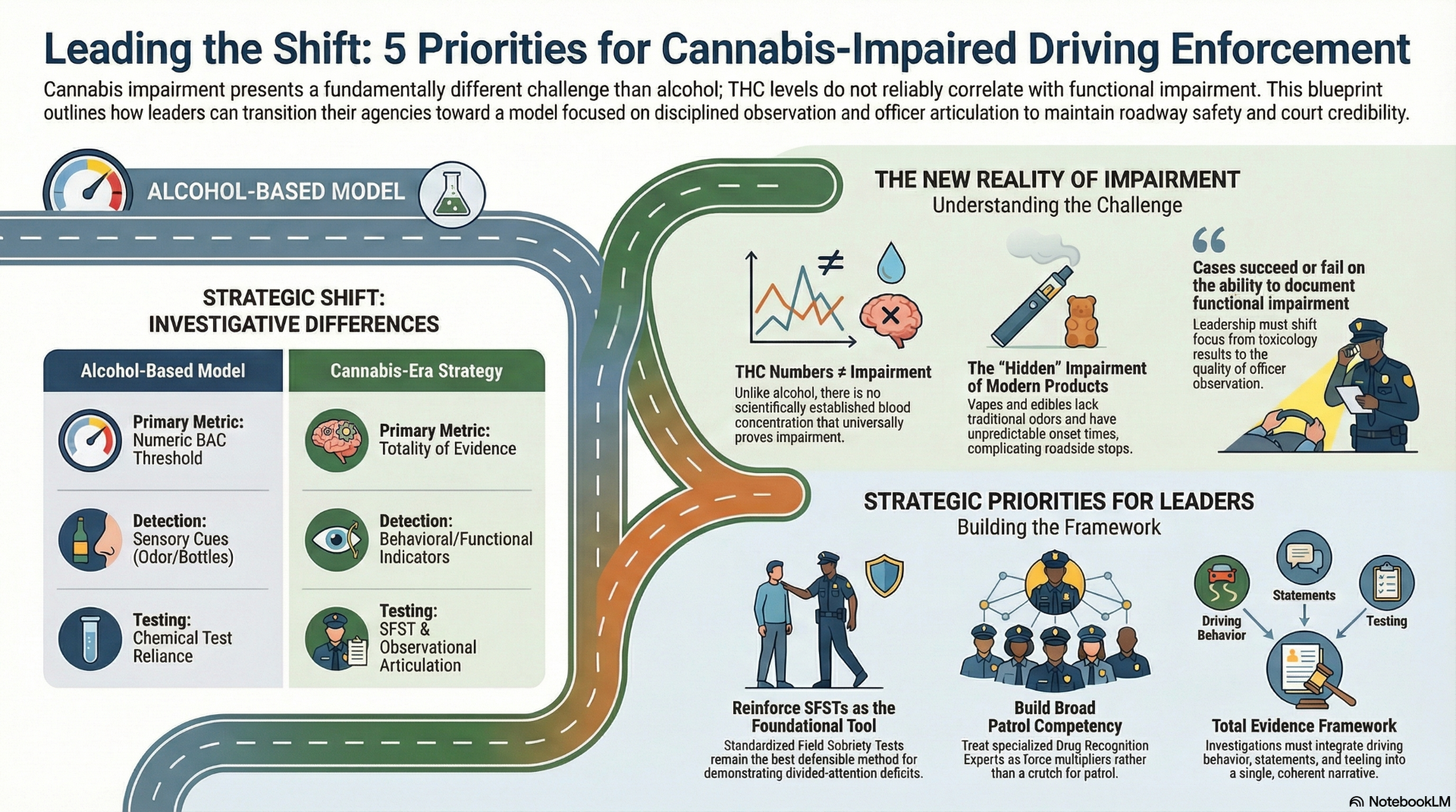
Priority 1: Treat Cannabis as a Legitimate and Distinct Impairment Risk
Cannabis can impair driving, and it can undermine a user’s ability to accurately judge their own impairment. Research and practitioner experience consistently indicate that cannabis affects attention, reaction time, coordination, and decision-making—capabilities essential to safe vehicle operation. It can also interfere with self-assessment, creating a dangerous mismatch between what drivers feel and how they actually perform.[4]
For police leaders, the operational takeaway is not simply that “cannabis impairs,” but that cannabis impairment often presents differently than alcohol impairment. On a traffic stop, the driver may deny drinking, appear calm, and show no alcohol odor—yet still demonstrate significant impairment when asked to perform divided attention tasks. Cases where functional impairment is visible, but traditional alcohol cues are absent are increasingly common, and they require agencies to ensure that officers recognize what impairment without alcohol can look like.[5]
Leadership implication: Chiefs and command staff set the organizational posture. When agency messaging treats cannabis impairment as a marginal problem—or frames it as primarily a political or cultural debate—officers will hesitate, enforcement will be inconsistent, and case quality will suffer. Clear executive direction that cannabis impairment is a traffic safety and public protection issue (not an ideology issue) helps officers apply consistent, professional, evidence-based practices.
Priority 2: Move Beyond THC Numbers to a Totality of the Evidence Model
A central enforcement challenge in cannabis impaired driving is that a person’s THC levels do not reliably correlate with impairment.[6] Unlike alcohol, there is no scientifically established THC blood concentration that indicates impairment across individuals.[7] THC can leave the bloodstream relatively quickly while impairing effects persist, and metabolites may remain detectable long after impairment has subsided.[8] Frequent users may have measurable THC levels without functional impairment, while occasional users may be impaired at relatively low concentrations.[9]
This reality creates predictable friction: officers may want a standard “prohibited” level of THC, prosecutors may face toxicology results that do not “match” observed impairment, and the public may be confused why a level of intoxicants should decide the case with alcohol, but not cannabis. A leadership-level response is to ensure the organization is aligned around a totality of the evidence framework—one that integrates driving behavior, officer observations, statements, field sobriety testing, and toxicology, rather than relying on a single numeric value.
Leadership implication: Policies, training, and supervisory review should reinforce that cannabis impaired driving investigations rise or fall on documentation quality and articulation—not on a number. Leaders should ensure that patrol and supervisors share a common evidentiary “North Star”: functional impairment supported by coherent observation and lawful investigative steps, with toxicology treated as one component of a larger proof structure.
Priority 3: Recognize the Operational Impact of Modern Cannabis Products
Modern cannabis is not a single, uniform product. Today’s market includes smoked cannabis, vaporized products, edibles, and concentrated forms, and overall THC concentrations in these products have increased compared with prior decades.[10] The effects of these products vary widely in onset time, duration, and intensity. For example, edibles may produce delayed impairment that occurs well after consumption, while inhaled products may produce more immediate but shorter lived effects.
For agencies, this product diversity has two direct consequences. First, it complicates roadside investigations because officers may confront impairment timelines that do not fit outdated assumptions about use and effect. Second, many cannabis products are easily concealed, reducing the likelihood of obvious physical evidence during a stop. In practice, this increases reliance on behavioral indicators and officer competence rather than on visible contraband or “classic” sensory cues.
Leadership implication: Chiefs and command staff should anticipate and normalize this complexity in agency expectations. When leaders implicitly expect cannabis cases to look like alcohol cases, officers feel set up to fail. Leaders can reduce that friction by aligning training and supervision to modern realities: variability in onset and duration, reduced physical evidence, and the need for consistent observational practice.
Priority 4: Reinforce SFSTs as the Foundation of Cannabis Impaired Driving Investigations
Impaired driving enforcement is fundamentally concerned with functional impairment, not the specific substance causing it. Driving requires divided attention—the ability to manage multiple tasks at once—and impairment often manifests as deficits in this capability. Standardized field sobriety tests (SFSTs), while originally validated for alcohol impairment, remain valuable tools for identifying impairment related deficits when properly administered. They can reveal issues with balance, coordination, attention, and information processing.[11]
Importantly, SFSTs are not “cannabis-specific tests,” and leaders should be careful not to overpromise what SFSTs do. Their strength lies in their ability to demonstrate impairment-related performance problems and to provide officers with a structured, defensible method of observation and articulation.[12] Research supports their use as part of a broader investigative framework, especially when combined with driving behavior and other indicators of impairment.[13]
Leadership implication: SFST quality is a leadership issue. When agencies treat SFSTs as a checkbox item, performance degrades, credibility weakens in court, and officers lose confidence. Leaders can strengthen outcomes by emphasizing SFST proficiency as a foundational investigative skill—one that remains critical even as drug impairment cases increase. Supervisory review and coaching should reinforce consistent administration and clear articulation so that SFSTs support, rather than substitute for, a totality of the evidence case narrative.
Priority 5: Build Broad Patrol Capability While Leveraging Specialized Expertise
Drug recognition experts (DREs) undergo advanced training in identifying impairment caused by drugs and can significantly strengthen investigations, particularly in serious injury and fatal crash cases where impairment may not be immediately apparent. Their involvement can improve the quality of impairment assessments, enhance documentation, and provide more robust testimony.
At the same time, most impaired driving encounters begin with patrol officers who are not DREs. Given the limited number of DREs and the practical constraints of training entire agencies to that level, broad patrol competency becomes essential. Chiefs should ensure that all patrol officers are equipped to recognize, investigate, and document cannabis impairment effectively—because officers cannot be expected to address what they do not recognize. In many agencies, success depends as much or more on baseline patrol capability than on specialized expert availability.
Leadership implication: Executives should treat specialization as a force multiplier, not a crutch. The most resilient model pairs strong patrol fundamentals with targeted deployment of DRE resources where they add the most value. That requires leaders to be intentional about training priorities, supervision, and operational expectations so that patrol officers can initiate high-quality cases and specialists can enhance them when feasible.
Leading the Transition to a Cannabis Era Impaired Driving Strategy
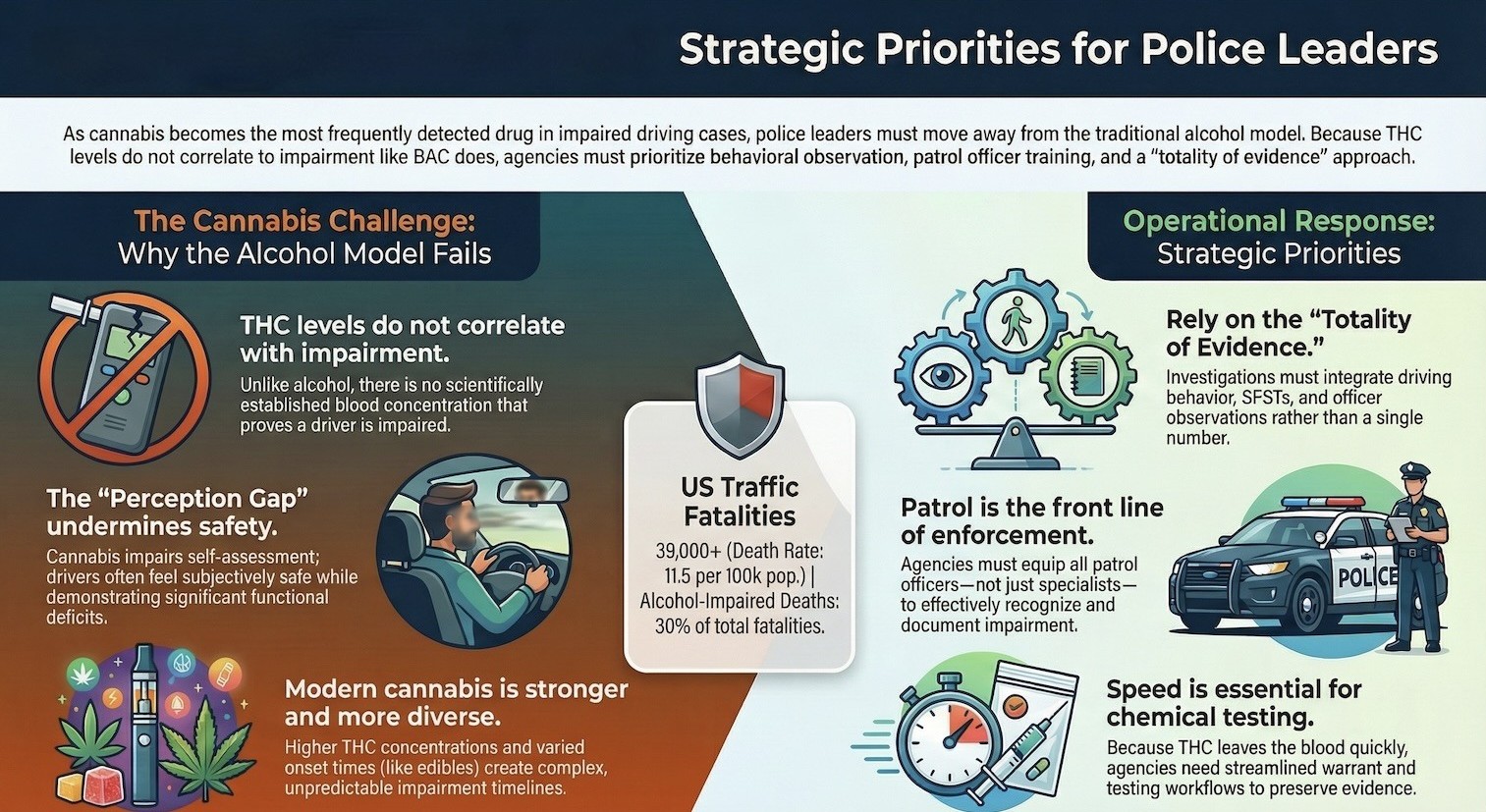
Cannabis impaired driving is no longer an emerging issue—it is an operational reality that intersects with enforcement, training, supervision, prosecution, and public trust. The challenge for police executives is not simply to “do more DUI enforcement” but to ensure their organizations are prepared for cases that do not conform to alcohol-based assumptions: impairment without traditional alcohol cues, toxicology numbers that do not neatly translate to functional impairment, and product-driven variability that complicates timelines and detection.
Leadership can make the difference between uneven, discouraging enforcement and a credible, sustainable public safety response. Agencies that treat cannabis impairment as a legitimate and distinct risk, anchor investigations in a totality of the evidence practice, account for modern product realities, reinforce SFST proficiency, and build broad patrol capability while leveraging specialists will be better positioned to protect lives on the roadway. Just as important, they will be better positioned to maintain confidence in the justice process by presenting cases that are coherent, well documented, and grounded in observable impairment rather than assumptions or shortcuts.
__________________________________________________________________
[1] National Highway Traffic Safety Administration (NHTSA), “Early Estimate of Motor Vehicle Traffic Fatalities in 2024,” Traffic Safety Facts, April 2025.
[2] F. D. Thomas et al., Drug Prevalence Among Seriously or Fatally Injured Road Users (NHTSA, 2022).
[3] National Traffic Law Center (NTLC), Investigation and Prosecution of Cannabis-Impaired Driving Cases (National District Attorneys Association (NDAA), 2020).
[4] Frederick Vinckenbosch et al., “Validating Lane Drifts as a Predictive Measure of Drug- or Sleepiness-Induced Driving Impairment,” Psychopharmacology 237, no. 3 (2020): 877–886; Thomas Marcotte et al., “Driving Performance and Cannabis Users’ Perception of Safety: A Randomized Clinical Trial,” JAMA Psychiatry 79, no. 3 (2022): 201–209; Ryan Miller et al., “Influence of Cannabis Use History on the Impact of Acute Cannabis Smoking on Simulated Driving Performance During a Distraction Task,” Traffic Injury Prevention 23, no. S1 (2022): S1–S7.
[5] NTLC, Investigation and Prosecution of Cannabis-Impaired Driving Cases, 17.
[6] Kari Declues, Shellie Perez, and Ariana Figueroa, “A 2-Year Study of Δ 9-tetrahydrocannabinol Concentrations in Drivers: Examining Driving and Field Sobriety Test Performance,” Journal of Forensic Science 61, no. 6 (2016): 1664–1670; Rebecca L. Hartman et al., “Drug Recognition Expert (DRE) Examination Characteristics of Cannabis Impairment,” Accident Analysis & Prevention 92 (2016): 210–229; NTLC, Investigation and Prosecution of Cannabis-Impaired Driving Cases, 14.
[7] Declues, Perez, and Figueroa, “A 2-Year Study of Δ 9-tetrahydrocannabinol Concentrations in Drivers”; Hartman et al., “Drug Recognition Expert (DRE) Examination Characteristics of Cannabis Impairment,” NTLC, Investigation and Prosecution of Cannabis-Impaired Driving Cases, 14.
[8] NTLC, Drug Toxicology for Prosecutors (NDAA, 2023): 13, 20–21, 181–182.
[9] NTLC, Drug Toxicology for Prosecutors,13, 20–21, 181–182.
[10] Malcolm Ferguson, “Marijuana Is Too Strong Now,” The Atlantic, August 29, 2024.
[11] Thomas D. Marcotte et al., “Evaluation of Field Sobriety Tests for Identifying Drivers Under the Influence of Cannabis: A Randomized Clinical Trial,” JAMA Psychiatry 80, no. 9 (2023): 914–923; Johannes G. Ramaekers, Frederick Vinckenbosch, and Jodi M. Gilman, “High Traffic—The Quest for a Reliable Test of Cannabis Impairment,” JAMA Psychiatry 80, no. 9 (2023): 871–872; W.M. Bosker et al., “A Placebo-Controlled Study to Assess Standardized Field Sobriety Tests Performance During Alcohol and Cannabis Intoxication in Heavy Cannabis Users and Accuracy of Point of Collection Testing Devices for Detecting THC in Oral Fluid,” Psychopharmacology 223, no. 4 (2012): 439–446.
[12] NHTSA, DWI Detection and Standardized Field Sobriety Testing: Participant Manual (2023).
[13] Declues, Perez, and Figueroa, “A 2-Year Study of Δ 9-tetrahydrocannabinol Concentrations in Drivers”; Hartman et al., “Drug Recognition Expert (DRE) Examination Characteristics of Cannabis Impairment,” 224–225.