
While the tools and procedures have evolved, the principles of diligent, thoughtful policing and the importance of clear communication have remained constant.
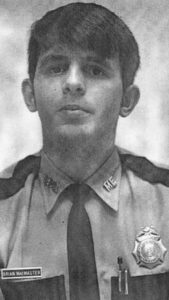 Having been in law enforcement for 55 years, I have often been asked about the differences in policing between my beginning and now. As you might imagine, things were starkly different in 1969. The best thing I had going for me at the time was that I could read and write fairly well. As unlikely as it may seem, those were attributes not commonly seen in many officers, at least the ones with whom I worked.
My contemporaries at the time were 10-20 years older. I was 20 years old and newly married. The majority age was 21, which meant I could handle liquor in the course of my employment, but couldn’t buy or consume it. The chief gave me an ill-fitting uniform and a duty belt that was so big that it necessitated punching new holes in it to accommodate the buckle. The hat he handed me was too small.
My first day on the job was a Sunday, and I worked alone because “nothing ever happens on a Sunday.” I barely had an idea of what I was supposed to do. It wasn’t much different than pulling someone off the street and giving them a badge and a gun. My first arrest was that morning when I nabbed a guy driving a stolen car, a huge fellow whose wrists were too big for the handcuffs. Zip ties? Unheard of. Fortunately, he was somewhat pleasant, at least not a fighter. The on-duty firefighters walked me through the booking and bail process. Shortly after, during that quiet Sunday, I found myself dealing with a shotgun suicide and then a woman on the bridge determined to jump off into the river. “Nothing ever happens on a Sunday,” they said.
Our two-way radios were antiquated. They only worked within a few miles of the station. There were no dispatchers, no 9-1-1. The telephone was answered by firefighters who never saw that as part of their job, especially at night when they were trying to sleep. When the radio didn’t work, they would summon us by activating red lights strategically placed on utility poles around downtown. This meant that at least one officer on shift had to hang around downtown, primarily on foot. Of course, that assignment always went to the rookie. The sirens on the same poles screamed if the red lights failed to summon the officer. We would find a telephone or walk to the station.
There were no instant BMV, SBI, or NCIC checks. We waited for weeks for those. No backup. Even if there was backup, there was no easy way to call for it. No training or even orientation. No FTO. It was all OJT, with all the mistakes you can imagine thrown in. Policies or a procedures manual? Stupid question! None of that is needed; you can always figure out what to do. Just use common sense. I didn’t get any police-related training until more than a year on the job, when I completed the 70-2 session of a basic police school sponsored by the Maine Municipal Association at Camp Kyes in Augusta. And it was all in the classroom. No MARC, no firearms, no EVOC. And, by the way, there were no ALERT tests, polygraphs, or psychological or physical fitness requirements.
I learned the PIT maneuver early on from a seasoned state trooper and used it successfully more than once. We didn’t call it the PIT maneuver; it didn’t have a name, but it worked. Recently, I participated in PIT maneuver training and found I could still do it successfully. Love the PIT maneuver! The state troopers in the area were the best. Always willing to help, always willing to walk you through the steps. I always got along great with all of them; I think they felt sorry for me or saw me as an experiment of sorts. There were deputy sheriffs, but no patrol; they were criminal investigators.
We had no portables, cell phones or smartphones, pagers, MDTs, or computers. No email. No spelling or grammar check. No photocopiers, no fax machines. No cruiser cams. No body cams. No digital cameras. No color film. None of it existed. And nothing better than a huge reel-to-reel monstrosity for audio recording. We were connected to the outside world by a teletype machine, like the one you now see in police museums.
There were no handy Ferdico Criminal Statutes or Motor Vehicle Statutes, no LEOM, and no what we now know as the Maine Criminal Code. We worked with a combination of incomplete statutes and unwritten common law and drafted our own court complaints with as much imagination and creativity as we could muster.
Each county had one part-time elected county attorney, who appointed one part-time assistant county attorney. They both continued full-time private practices. They only prosecuted felony crimes in the Superior Court. Everything in District Court, including prosecuting cases and bindovers, was up to us. We weren’t that far into the District Court system that replaced municipal courts, commonly referred to as “police courts,” which recognized the local police’s control over judicial proceedings in those courts.
But, we had really neat cruisers – always the biggest and the fastest, like the 460 Ford and the 454 Chevy, either of which could easily do a buck forty on a good straight stretch. The single blue bubble light on the rooftop wouldn’t rotate in the cold; we had to pound on the roof’s interior to loosen it up. There were no front-wheel or all-wheel drive cruisers; we had to install chains on at least one cruiser every snowstorm, which limited us to no more than 45 m.p.h. And we didn’t need reasonable suspicion to stop a person or a car. “Reasonable suspicion” was a new term whose effects didn’t take hold on vehicle stops until 1979, two years after I left patrol. We were not required to “justify” a stop.
Our duty belts included a .38 revolver (the cylinder on the one issued to me would not rotate), an ammo dump pouch with 12 rounds, a set of handcuffs, and a ring for a wooden nightstick – which most of us left in the cruiser. No semi-automatics, shotguns, or rifles, no mace or paper spray, no TASER, RADAR, VASCAR, or LIDAR. Pinching a speeder required a 3/10ths-of-a-mile clock, then dropping it by 10 miles per hour. It was challenging, especially at night. I won’t say we didn’t do it at times with headlights out because I wouldn’t be telling the truth.
No DNA, no implied consent law, no breathalyzer, no balloon test, and a required blood-alcohol level of 0.15 or more on those rare occasions when you could persuade a suspected drunk driver to give up some blood.
And anything we charged was a crime and required us to prove it beyond a reasonable doubt, whether it was speeding or squealing tires, rape, or high and aggravated assault.
But we got convictions.
We did it by taking advantage of our experience, trusting and following our instincts, and gathering our information and evidence within the boundaries of the law and the Constitution, at least to the extent of our familiarity with such rules. Most importantly, we did it by writing a good report that described our observations and actions in exact, objective detail. We relied totally on these factors because we had little else to rely on. Even though we rarely had a chemical test, we hardly ever lost a drunk driving case. The conviction resulted from our testifying about our observations. We spent a lot of time in court because drunk driving and other cases were seldom bargained to something lesser in exchange for a guilty plea.
So, here’s a lesson: if you can’t write a good report or find yourself having a tough time at it, fix it now. It can’t wait. You can be the best street cop or investigator who’s ever come down the pike, but it will be all for naught if you can’t write a report. Do what you must now to overcome the difficulty of documenting your observations and actions in a report. In its simpler terms, it’s only a matter of describing what you did and why you did it. If you don’t become proficient at it, your career becomes one of disappointment and frustration, and you blame your failures on others in the system.