
The Plain View Exception to the Warrant Requirement
An officer who is lawfully present in a location may make a warrantless seizure of an item for which there is probable cause to believe is contraband or evidence of a crime, provided that the officer has a lawful right of access to the item and the seizure does not involve other reasonable expectation of privacy intrusions.
The plain view exception to the warrant requirement is easy to misinterpret or misunderstand. Just because an officer can see contraband does not necessarily mean the officer can seize it without a warrant or other exception to the warrant requirement. For example, the plain view exception does not allow entry into private premises or other constitutionally protected areas, even if the person or object subject to seizure is visible from the outside. The plain view exception requires certain prerequisites:
- The officer must be legally present where a plain view observation occurs,
- The officer must have a lawful right of physical access to the item observed, and
- It must be immediately apparent that the item is evidence of a crime or contraband. “Immediately apparent” means a probable cause belief at the time of the observation of the item in question. The officer may not physically manipulate the item to develop probable cause.
Lawful Presence. The officer must have a legitimate legal basis to be at the location from which the item is observed. This may arise from a constitutionally valid stop, search, or arrest, voluntary consent, or another recognized exception to the warrant requirement, such as exigent circumstances. Importantly, should the officer ultimately be in the location unlawfully, then any plain view seizure cannot be supported under the plain view exception.
Inadvertent Discovery. Until 1990, it was necessary to prove that an officer’s discovery under the plain view exception was unintentional or “inadvertent.” If credible evidence showed that lawful entry was intended to find items suitable for seizure, the plain view exception would not apply. However, the Supreme Court removed this requirement, provided that the seizure complies with the other rules governing the plain view exception.[1]
The plain view exception portends a seizure, not a search.
Plain View Exception on Private Premises with No Warrant. A 1987 U.S. Supreme Court case highlighted why it matters that something is “immediately apparent” and reinforced the prohibition against moving or manipulating objects to establish probable cause. In that case, an officer lawfully entered a home and saw high-quality stereo equipment that appeared out of place in an environment otherwise surrounded by low-quality, modest furnishings. The officer picked up a stereo part and turned it over to check the serial number against stolen property records. The Court ruled that the officer’s action was a warrantless search without probable cause. The serial number was not plainly visible, and the officer had to move and handle the item to verify its status as stolen property and, thereby, subject to seizure.[2]
Plain View Exception on Private Premises with Warrant. If, during a lawful search with a warrant, items that are clearly evidence of a crime are discovered, those items can be seized on the spot under the plain view exception even if they are not listed in the warrant and are unrelated to the original reason for the search. Again, the officers are lawfully present, the items are in plain sight, and their incriminating nature is immediately obvious. Officers cannot move items to find evidence and must have probable cause to believe the item is contraband.
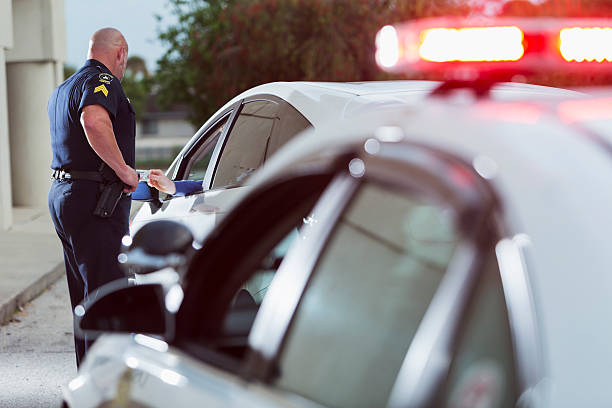
Plain View Exception during Vehicle Stop. An officer lawfully stops a car and has reasonable suspicion that an easily accessible firearm is present, thereby justifying a “frisk” of the car. During the frisk, the officer sees a substance in a glassine bag on the center console for which there is probable cause to believe is cocaine. The officer may seize the substance. The officer was lawfully present in the vehicle, the cocaine was in plain view, the cocaine was immediately apparent to be evidence of a crime, and no further intrusion was necessary to effect the seizure. Conversely, if the officer were standing outside the vehicle and saw the bag of cocaine, the officer could not lawfully seize the bag under the plain view exception. To seize the bag, the officer would have to enter the car, and such an intrusion would require justification beyond viewing the cocaine, i.e., a search warrant or a legally recognized exception to the warrant requirement. In this example, the officer’s observation of the cocaine would constitute probable cause for a warrantless search of the car under the automobile exception to the warrant requirement.[3]
Summary
The plain view exception is limited in scope. It allows police to seize evidence without a warrant only when three conditions are satisfied: the officer is (1) lawfully present, (2) has a legal right to access the item, and (3) it is immediately obvious that the item is evidence or contraband. Officers cannot enter protected areas based solely on what they see or manipulate items to establish probable cause.
[1] Horton v. California, 496 U.S. 128 (1990).
[2] Arizona v. Hicks, 480 U.S. 321 (1987).
[3] Carroll v. United States, 267 U.S. 132 (1925).